Oblivion
Oblivion centers on portraits of figures whose actions, decisions, resistance, or symbolic presence have shaped the traumatic landscape of my generation. Structured as seven interconnected works, the project moves through moments of rupture in contemporary Iranian history, from the Iranian Revolution to more recent episodes of political violence and regional conflict. Within these histories, the figures occupy profoundly different positions: some caused or administered violence, while others resisted it, became its victims, or came to symbolize its consequences.
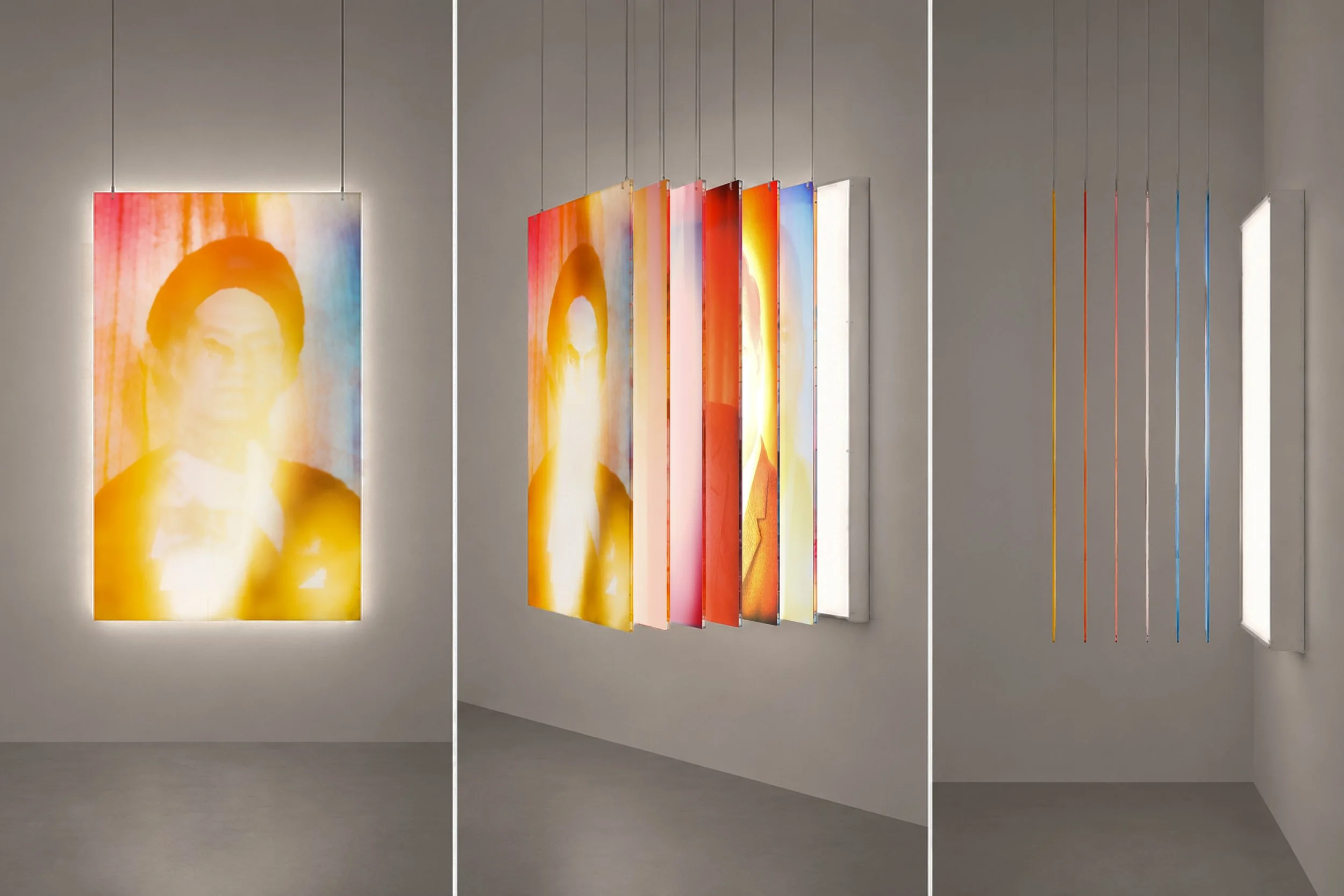
Each work consists of layered, manipulated photographic portraits printed on transparent acrylic sheets, suspended from the ceiling and illuminated from behind. The portraits associated with a particular historical moment are positioned sequentially in space. Seen from the front, even a slight movement causes the images to dissolve into one another, merging into a single unstable figure. As the viewer moves around the work, the layers begin to separate, and from the side the individual portraits become distinctly visible.
At its core, Oblivion engages the tension between the desire to forget and the impossibility of erasure. The portraits oscillate between presence and disappearance, individuality and entanglement—persistent, involuntary, and resistant to closure.
Oblivion resists the comfort of historical amnesia. It confronts viewers with overlapping afterimages of power, resistance, loss, and consequence, where the past does not recede, but remains active—continuing to shape both individual and collective consciousness.
Installation visualization: Iranian Revolution
Each photographic image is printed on a clear acrylic panel measuring 75 × 115 cm
Acrylic panels are suspended in sequence with rear illumination; overall dimensions vary according to the number of portraits in each work.
Oblivion, New York, 2024-26 © Tooraj Khamenehzadeh